
Red Light Therapy serving Clear Lake, TX.
Not just a gym. A daily retreat.
Wavelength-specific 660nm and 850nm panels, used as a timed protocol rather than an ad-hoc amenity. Programmed alongside training and the rest of the recovery suite.
The drive from Clear Lake
About 15 to 25 minutes to 104 Whispering Pines Ave, Friendswood — Bay Area Boulevard west, or NASA Parkway (FM-528) toward Friendswood.
From Clear Lake
The short drive west on FM-528.
Clear Lake sits 15 to 25 minutes from Friendswood by straightforward routes. Bay Area Boulevard runs west directly toward the facility. NASA Parkway — FM-528 — carries traffic from the heart of the community through Webster and into Friendswood without a single complicated interchange. Residents of Bay Oaks, Brook Forest, and University Green tend to find El Dorado Boulevard to FM-528 the cleanest line. The drive is unhurried, and most guests fold it into a lunch window or the tail end of a workday.
Wellness Elite Fitness is located at 104 Whispering Pines Ave, Friendswood, TX 77546. The recovery suite — where the photobiomodulation panels are housed — is open 7 a.m. to 7 p.m. The strength floor operates 24 hours a day for members. No appointment and no membership are required to walk the floor first; a day pass covers a single red light session, and rates are fixed and printed at the front desk. Guests from Clear Lake, Nassau Bay, and the surrounding area arrive, use the facility, and are back on FM-528 within the hour.
WHO COMES FROM CLEAR LAKE
Engineers, scientists, and shift workers chasing deep recovery.
The Clear Lake area runs on long cognitive shifts. Engineers and scientists at Johnson Space Center and the surrounding aerospace corridor carry screen-heavy, high-concentration workloads that accumulate as physical tension as readily as any manual trade. Red light therapy — sessions spent still, warm, and offline — offers a recovery input that asks nothing of the mind. For a community that earns its rest, that distinction matters.
University of Houston-Clear Lake faculty and students, maritime professionals who work odd schedules on the water, and Bay Oaks residents who commute into Houston's energy corridor all find the 15-minute run down FM-528 a reasonable trade. The modality fits a precise, evidence-attentive population: something measurable, passive, and repeatable, slotted cleanly between obligations.
See it
What it looks like.
The program
How photobiomodulation works.
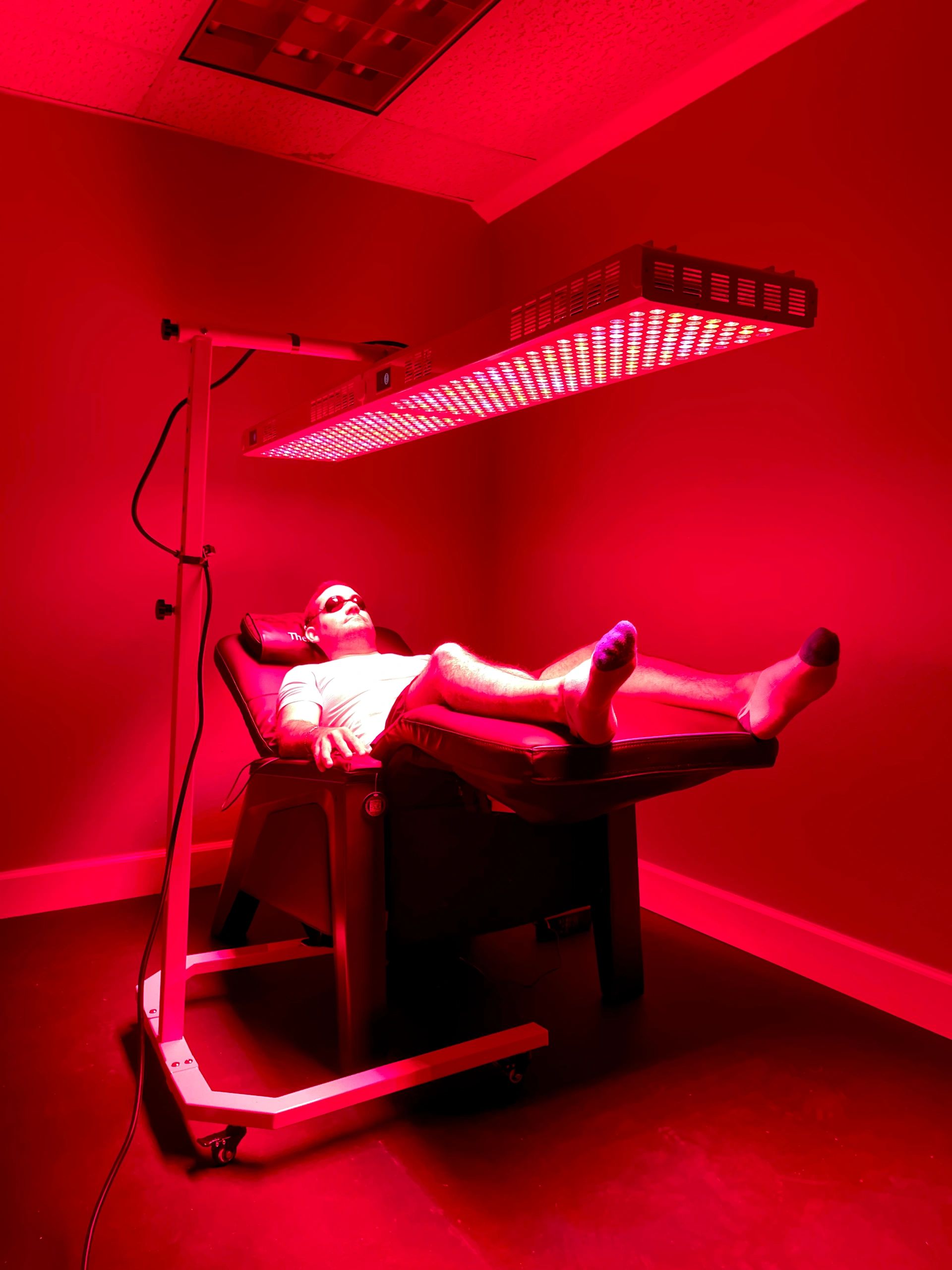
Red light therapy - photobiomodulation, in the literature - delivers specific wavelengths of light to skin and shallow tissue. The cellular target is mitochondrial cytochrome c oxidase. The downstream effect is a measurable shift in cellular respiration, with associations in the research literature to recovery, skin signal, and sleep architecture.
We use 660nm panels for skin-depth signal and 850nm panels for slightly deeper tissue. Sessions are 10 to 20 minutes, three to four times per week, and timed against training load - particularly in the 2 to 6 hours after a heavy strength session, when the recovery signal is strongest.
Use cases
What members use it for.
Three patterns dominate: post-training recovery, skin signal (members on the cellular health plan), and sleep architecture (members who use the panel in the early evening). We do not recommend the panel as a primary treatment for any condition; we use it as one of seven recovery-suite signals in a coherent week.
What it is not
Honest limits.
Red light therapy is not a substitute for sleep, training, or a serious nutrition plan. Used as a timed adjunct, it produces measurable effects. Used as a stand-alone hope, it does not.
"I started using the panel after squat sessions. By the third week the next-day soreness was noticeably less. I do not know exactly why; I just keep doing it."A WEF member
Common questions
What members ask before booking.
Red light therapy at WEF draws a specific kind of member: someone already putting in real work — in the strength room, through a recovery protocol, or post-procedure — who wants to make that work land more completely. Photobiomodulation is not a shortcut. What it does is sharpen the cellular environment in which your other investments happen. The members who see the clearest results here are those managing delayed-onset muscle soreness between training blocks, navigating soft-tissue recovery after orthopedic or aesthetic procedures, or working on inflammatory load that's blunting their sleep and energy baselines. If you're coming to WEF primarily for IV nutrition or a structured strength program, red light is a natural complement — not an add-on for its own sake, but a modality that amplifies what's already in motion.
Within the WEF recovery suite, photobiomodulation is most commonly paired with contrast therapy — sauna followed by red light — or used in the 30-minute window immediately after a strength session before cryo. That sequencing is intentional. The near-infrared wavelengths (typically 810—850 nm) work alongside the vasodilatory effect of the sauna or the post-exercise metabolic window to support mitochondrial ATP production and reduce localized oxidative stress. For members on HBOT protocols, red light is often scheduled on alternating days to avoid overlapping systemic demands on recovery bandwidth.
Your first session at WEF runs a full orientation before exposure begins — positioning, distance to panel, eye protection protocol, and a brief intake conversation about current medications or photosensitive conditions. Expect roughly 10—20 minutes of actual exposure time. You will not feel dramatic heat. Some members notice a mild warmth; most notice nothing during the session and report better sleep or reduced joint stiffness within 24—48 hours of the first few sessions. That subtlety is normal and consistent with the research.
Frequency depends on goal. For general recovery and mitochondrial support, two to three sessions per week fits most member schedules at WEF. For acute soft-tissue work — a nagging shoulder, post-procedure inflammation — daily sessions for two weeks followed by a maintenance cadence is the approach Dr. Swet Chaudhari, MD (Medical Director of Elite Aesthetic MD, the independent practice located inside the WEF building) has used with members who sought clinical guidance through that practice. Red light is cumulative and dose-dependent; the members who treat it casually get casual results. A brief program conversation at intake makes the difference.
The protocol at WEF.
WEF uses full-body panel systems delivering both red (630—660 nm) and near-infrared (810—850 nm) wavelengths at therapeutic irradiance levels — not the low-output consumer devices members may have encountered elsewhere. Sessions run 10 to 20 minutes depending on goal and placement, with members positioned at a calibrated distance (typically 6—12 inches from the panel surface) to ensure effective fluence delivery without dissipating the dose across too much air gap. The Friendswood facility is set up to run red light within the same visit as infrared sauna, strength training, or IV therapy without scheduling conflict — those integrations are built into how the recovery suite flows, not improvised.
For members in active strength programming at WEF, the protocol typically places red light in the post-training window before any cold exposure — preserving the inflammatory signaling that supports adaptation while supporting mitochondrial efficiency and tissue repair downstream. For members whose primary goal is skin quality, collagen remodeling, or post-aesthetic procedure support, sessions are often scheduled independently of exercise, mid-morning or mid-afternoon, when cortisol is not elevated. Contraindications — including active photosensitizing medications, certain thyroid conditions, and pregnancy — are reviewed at WEF's intake conversation. Members who want clinical evaluation of these factors may do so through Dr. Swet Chaudhari, MD at Elite Aesthetic MD, the independent practice located inside the building. Nothing here is assumed.
Frequently asked.
Is the drive from Clear Lake worth it for a single red light session?
Most guests from Clear Lake, Bay Oaks, and University Green find the 15-to-25-minute run on FM-528 or Bay Area Boulevard fits naturally around a lunch break or an early-evening window. A single day-pass session covers the full red light panel time in the recovery suite, and many guests combine it with time in another recovery amenity the same visit.
Do I need a membership or an appointment to try red light therapy at WEF?
Neither. Walk in, purchase a day pass, and use the recovery suite the same visit. The suite is open 7 a.m. to 7 p.m. Membership carries additional privileges, but it is never a prerequisite for a first session. Everyone is welcome — bring a colleague from JSC or come alone.
Is there a red light therapy option closer to Clear Lake that I should consider first?
There are tanning-based red light add-ons at some local salons, but WEF's recovery suite uses dedicated full-body photobiomodulation panels in a purpose-built wellness setting — a meaningfully different experience. The short drive to Friendswood is part of the value: a clean separation from the work environment and a facility built around recovery rather than offering it as an afterthought.
Red light therapy benefits for skin?
The 660nm wavelength is associated in the literature with collagen-related skin signals over a sustained, programmed cadence. Members on the cellular health plan typically see the effect by week 6-8.
How often should I use red light therapy?
3 to 4 times per week, 10 to 20 minutes per session. Less is too rare; more saturates the signal.
Red light vs infrared sauna?
Different mechanisms. Red light is wavelength-specific photobiomodulation; infrared sauna is heat. We program both - they are not interchangeable.
Is red light therapy safe?
Generally well-tolerated. Eye protection is provided. Members on photosensitizing medications should mention the prescription before sessions begin.
How far is Wellness Elite from Clear Lake, TX?
About a 12-minute drive. We are in Friendswood at 104 Whispering Pines Ave; many of our members commute from Clear Lake, League City, and Webster. For training-led members: Clear Lake personal training.
Does red light therapy help with athletic recovery and muscle soreness?
Yes — the mitochondrial signal red light provides supports cellular ATP production and reduces the local inflammatory response after heavy training. Members on a meaningful training block typically pair red light with infrared sauna and compression for the first 24—48 hours post-session, then with hyperbaric oxygen on heavier weeks. The effect compounds across a training cycle rather than appearing in a single session, which is why we program it weekly rather than as needed.
How does red light therapy at WEF differ from a home red light panel or face mask?
Power density and wavelength precision. Consumer panels typically deliver lower irradiance and broader spectrum, which means longer sessions are needed to reach a comparable dose — and most members do not sustain that cadence. WEF's panels deliver clinical-tier irradiance at the wavelengths (660nm, 850nm) most associated with mitochondrial response, sequenced into the broader recovery suite by a coach who reads the dose against your training load and recovery markers.
Can red light therapy be combined with longevity-track protocols at WEF?
Yes — red light is one of the cleanest pairings inside the longevity track. Used alongside hyperbaric oxygen, the combination targets mitochondrial function from two angles (light-driven cytochrome c oxidase activation + oxygen-driven cellular respiration). Members on the longevity track at WEF — coordinated by Dana Kantara, Cellular Health, and See the longevity program →


Sequenced into the recovery suite.
A modality on its own is a session. A modality sequenced against the strength block, the cellular health protocol, and the next training week is a practice. Membership unlocks the stack — the consult finds the right tier.
"All the most amazing cold/hot/light/massage/PEMF/HBOT therapies and recovery equipment."
Walk the suite.
A private tour of the recovery suite, the strength floor, and the consult room. No session required.
How it works.
Seven steps from first call to first quarterly re-test.
FAQ · 25 answers.
25 questions members ask most before joining.
Side by side.
Modality + facility comparisons from the editorial desk.
What it replaces.
Membership compared to the à-la-carte stack.
Clear Lake hub
More on the Wellness Elite Fitness floor serving Clear Lake — visit the Clear Lake gym hub →