
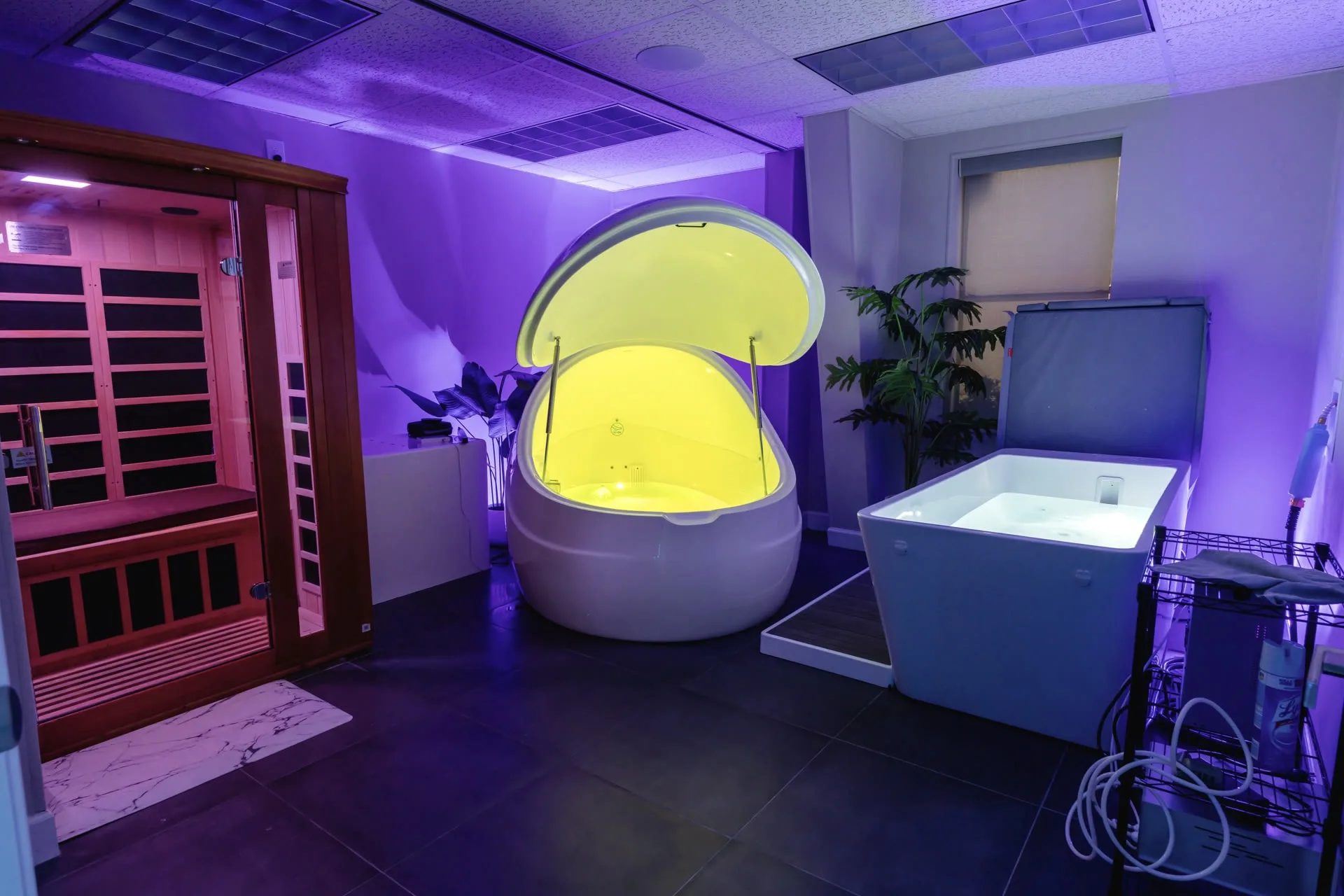
Most members’ first question about the float tank in Friendswood is some version of: am I going to be okay in there? It is a fair question, and the answer is yes — the cabin is larger than most people picture, you control the lighting, the door does not lock, and the entire experience is yours to dial up or down. The harder question is what to do with the 45 minutes once the door is closed and the water is doing what salt-saturated water does. That is what this guide is for.
If you have been searching float tank Friendswood or sensory deprivation Houston, here is the science, the protocol, and what to expect from your first session at Wellness Elite Fitness.
What sensory deprivation actually is
The technical name for the modality is floatation-REST — Restricted Environmental Stimulation Therapy. It was developed in the 1950s by neuroscientist John Lilly and refined into its current form across the 1970s and 80s. The idea is straightforward: reduce environmental sensory input as far as practically possible and observe what the nervous system does with the silence.
The cabin holds approximately ten inches of water saturated with about 800 to 1,200 pounds of magnesium sulfate (Epsom salt). The salt density is high enough that the body floats effortlessly — ears just below the waterline, face above. The water is heated to skin temperature, around 34 to 35 degrees Celsius (93 to 95 Fahrenheit), so the boundary between body and water gradually fades from perception. Light is attenuated to total darkness if you choose; sound is attenuated by the cabin and by the water itself. There is no clock, no phone, no screen, no music unless you ask for it.
The sensory load that the brain processes from minute to minute — visual, auditory, proprioceptive, gravitational — drops to a fraction of baseline. What happens next is the substance of the modality.
What happens during a first float at WEF — a 45-minute walkthrough
Arrival and orientation (0 to 10 minutes before entry)
You arrive in the recovery suite, sign the brief intake, and meet the operator. First-time members get a full walkthrough of the cabin: how the door works (it does not lock, it opens with a touch), where the lighting controls are (interior and exterior), the music settings (off by default; gentle ambient available), the call button, and the salt-rinse procedure on the back end. The operator answers any question. We do not rush this step.
Shower, suit-free entry, hair tied (10 to 15)
Members shower before entering — lotions, oils, and skin product are rinsed off. The float is done without clothing; the cabin is fully private. Hair is tied back if long. A small amount of petroleum jelly is applied to any open cuts (the salt finds them).
The first ten minutes inside
The most common first-time pattern is a small mental restlessness. The body is in unfamiliar conditions, the mind tries to figure out what it is supposed to do, and a few minutes of mental cataloguing happens (today, this week, the email, the kids). This is normal. There is no goal here; you do not have to meditate, you do not have to clear the mind, you do not have to do anything. Many members find it useful to begin with a few intentional slow breaths and let the experience be whatever it is.
Minutes 10 to 30: settling
By the second third of the session, the nervous system typically begins to shift. Heart rate drops several beats per minute. Breathing slows. The boundary between body and water becomes harder to locate. Members report a range of subjective experiences here — quiet wakefulness, a slow drift toward something like the hypnagogic state, occasional vivid imagery, occasional simple absence. None of these is the “right” experience. They are all the modality doing its work.
Minutes 30 to 45: the deep middle
The deepest physiological response usually settles in here. The 45-minute mark approaches as gentle music or a soft cue; the cabin signals the end of the float.
Exit and rinse (45 to 60)
You exit the cabin, shower thoroughly to remove salt, dress, rehydrate. The recovery suite is quiet by design; we do not push members back into traffic or noise immediately. Most members spend 10 to 15 minutes after the float in the lounge before driving.
“The float doesn’t do anything to you. It removes the things doing things to you, and the nervous system handles the rest.” — WEF Editorial
The cortisol-reset science
The published literature on floatation-REST is smaller than the literature on sauna or cold exposure, but it is consistent in direction. Two research groups have produced most of the modern evidence: Justin Feinstein’s lab at the Laureate Institute for Brain Research (LIBR) in Tulsa, Oklahoma, and the floatation research group at Karlstad University in Sweden.
Acute effects
In research settings, a single 90-minute floatation-REST session lowered blood pressure and shifted heart rate variability toward a parasympathetic state relative to a comparison condition PMID 36570829 (cardiovascular/HRV), and a single session reduced self-reported anxiety PMID 29394251 (anxiety). Repeated REST sessions over several weeks have been associated with lower plasma cortisol in healthy volunteers PMID 1864782 (cortisol). The acute parasympathetic shift — reduced heart rate, increased heart rate variability — is one of the more reproducible findings in the literature.
Cumulative effects
A 2018 study from Feinstein’s group reported that a single one-hour floatation session significantly reduced state anxiety in participants with generalised anxiety disorder, social anxiety disorder, panic disorder, agoraphobia, and post-traumatic stress disorder, with concurrent improvement in serenity and reduced muscle tension PMID 29394251. Subsequent work by the same group and by Swedish researchers has explored multi-session protocols (typically eight to twelve sessions over six to ten weeks) with continued benefit.
What the literature does not claim
It is worth being precise. Floatation-REST is not a treatment for any psychiatric condition; the published research is small-cohort and short-duration. What it consistently shows is a reliable acute parasympathetic response, and a tolerated cumulative effect across multi-session protocols. We treat it as one of the more reliable acute stress-reset interventions on the recovery floor, and we do not overclaim.
Member tips for a first float
- Eat lightly an hour before. A heavy meal makes the body uncomfortable; an empty stomach makes it noisy. Aim for the middle.
- Caffeine is optional. Coffee in the morning before an evening float is fine; coffee in the hour before the float will make settling harder.
- Skip the gym immediately before. Or do it three or four hours earlier. The float pairs better with a settled nervous system than a freshly-stimulated one.
- Don’t shave the night before. The salt is unforgiving on freshly-shaved skin.
- Use the earplugs. They are provided. The salt is corrosive in the ear canal otherwise.
- If you have long hair, tie it back loosely. The salt deposits in long hair if it floats free; a low loose tie keeps it manageable.
- Plan for the post-float lounge. Members who try to drive away within five minutes of exit miss most of the down-regulated state. Stay in the lounge for 10 to 15.
- Pair with cold or sauna across the day. Atlas often sequences a morning sauna with an evening float, or a post-training cold plunge with a same-week float, to layer the autonomic effects.
Who should not float
The contraindication list is short. Members with the following are screened out or referred to their treating physician for explicit clearance:
- Open wounds that have not closed
- Active ear infection (otitis externa or media)
- Uncontrolled epilepsy
- Severe claustrophobia that has not been worked with previously
- Pregnancy in the first trimester (and at any point with explicit physician clearance only)
- Acute psychotic episodes
- Skin conditions in active flare
Members with anxiety, PTSD, or depression who are interested in the float as part of a broader plan should review the protocol with their treating clinician first; WEF is a wellness facility, not a medical provider, and the float is a complement to clinical care, not a substitute.
Booking your first float
- Reserve a gym day pass. The day pass covers the strength floor (9 AM–5 PM, Mon–Fri) and a guided tour of the recovery suite; recovery, float, sauna, HBOT, red light, massage and stretch are member benefits.
- Complete the brief intake. Reviewed by the recovery team; members whose history warrants it are asked to get clearance from their own physician first.
- Book your first session with Atlas. Atlas, our member concierge, schedules the float against your training and recovery calendar. First sessions are 45 minutes inside the tank, 60 minutes total with shower and lounge time.
WEF is in Friendswood at 104 Whispering Pines Avenue. We serve members across Friendswood, Pearland, League City, Clear Lake, and the broader south Houston corridor. New members are welcome — tour the space — membership rates are fixed and printed on the lobby tier sheet. Membership covers the gym floor, MetCon classes, and Atlas; Platinum and above add the recovery suite. The float tank sits inside the broader recovery and wellness service set.
Frequently asked
What is a float tank?
A light- and sound-attenuated cabin or pool containing approximately 10 inches of water saturated with magnesium sulfate (Epsom salt), heated to skin temperature. The high salt density allows the body to float effortlessly while sensory input is reduced.
How long is a session?
A standard session at WEF is 60 minutes total — 45 minutes inside the tank, with shower and lounge time on either side. First-time members are walked through the cabin and the protocol before entry.
Will I feel claustrophobic?
The cabin is larger than most people picture, the door does not lock, and members control the lighting and the door position. Members concerned about claustrophobia begin with the cabin lights on and the door slightly ajar, and adjust to full darkness session by session.
What does the cortisol research show?
Studies report acute reductions in blood pressure and self-reported anxiety after a single session, and lower plasma cortisol across multi-session protocols in research volunteers. The strongest published work comes from the Laureate Institute for Brain Research and Karlstad University in Sweden.
Is the float tank a member benefit at WEF?
Yes. The float is part of the recovery suite and is a member benefit. First-time tour visits include an orientation; first sessions are scheduled by Atlas against your training and recovery calendar.
The float doesn’t do anything to you. It removes the things doing things to you.
The float tank at WEF is part of a recovery program, not a stand-alone purchase. Reserve a gym day pass and a VIP wellness tour to see the recovery suite in person.
Reserve a gym day pass →