
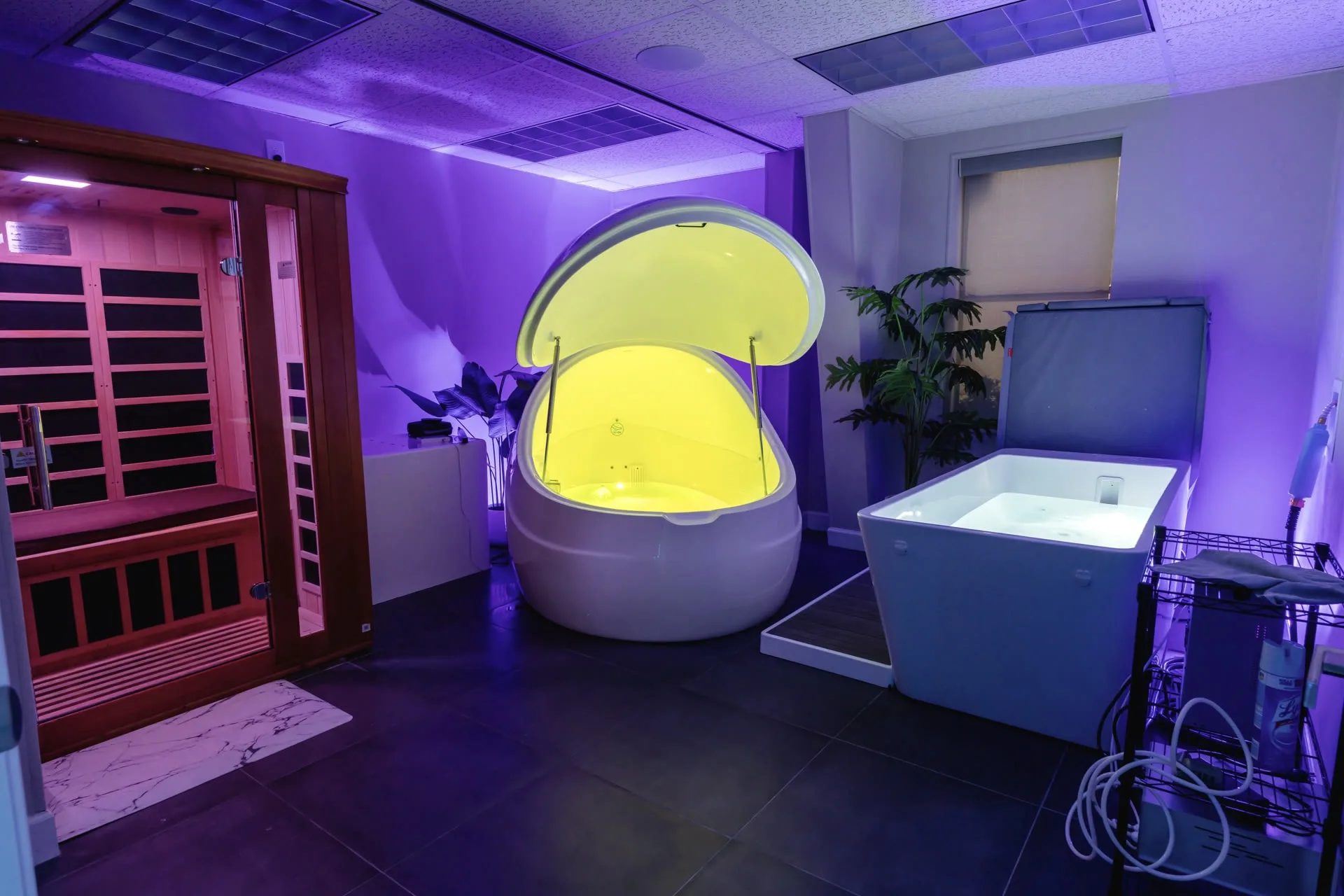
The term "sensory deprivation tank" carries residual strangeness — Cold War imagery, John Lilly’s mid-century isolation experiments, "Altered States" in wide release. What the clinical literature accumulated over the intervening fifty years tells a different story: floatation-REST (Restricted Environmental Stimulation Therapy) is among the more reproducible acute stress-reduction interventions in the peer-reviewed record. In an open-label study, a single session substantially reduced self-reported state anxiety (PMID 29394251). This page walks through what a sensory deprivation tank actually does to the nervous system, what the strongest published research supports, who derives the clearest benefit, and how Wellness Elite Fitness integrates float-REST into an evidence-based recovery framework at its Friendswood, Texas facility.
What a Sensory Deprivation Tank Actually Does.
A sensory deprivation tank — also called a float tank, float pod, or isolation chamber — is a light-attenuated, sound-dampened enclosure containing approximately 10 inches of water saturated with magnesium sulfate (Epsom salt) at a concentration of roughly 500 to 600 kg per 1,000 liters. That density is high enough that the human body floats without any muscular effort. The water is heated to mean skin-surface temperature — approximately 34.5 degrees Celsius (94.1 degrees Fahrenheit) — the threshold at which the thermal gradient between skin and environment is effectively zero. The body loses the ability to locate its own perimeter through heat contrast.
In darkness and near-silence, with gravity’s mechanical pull on joints and fascia removed, the nervous system is left without its three primary orientating inputs: visual signal, thermal gradient, and proprioceptive load. The result is not sleep — EEG studies confirm floaters remain awake and theta-dominant, not delta — but something more precisely described as supervised sensory quietude. The reticular activating system, the brain’s signal-gating mechanism, reduces its burden sharply. Metabolic activity in the amygdala and prefrontal cortex shifts. The default mode network — the architecture of self-referential thought — becomes active in ways that parallel advanced meditative states without requiring years of practice.
This physiological context matters for interpreting the research. Floatation-REST is not a passive experience. It is an active neurological event produced by deliberate environmental engineering. The clinical effects downstream of that event are what the literature now documents with increasing precision.
The Research Base.
Float-REST research has moved from anecdote to rigorous trial design over the past two decades. The field’s strongest contemporary work emerges from the Laureate Institute for Brain Research (LIBR) in Tulsa, from Sven Bood and colleagues at Karlstad University in Sweden, and from the Dharma Singh Khalsa group’s psychophysiological studies.
Who Actually Benefits.
The floatation-REST evidence base is broad enough that the more useful clinical question is not whether it works but who derives the clearest return on session investment.
Executives and high-cognitive-load professionals are the archetype for whom the research is most cleanly applicable. Chronic partial sleep deprivation, elevated ambient cortisol, and persistent default-mode suppression — the cognitive cost of always being on — are the defining stressors of senior professional life. Float-REST addresses all three simultaneously: cortisol suppression, parasympathetic restoration, and default-mode reactivation, in a single 60-minute window with no pharmaceutical side-effect profile.
Endurance and strength athletes benefit primarily through mechanical deloading and sleep-quality improvement. A competitive athlete logging 10 to 14 training sessions per week carries connective tissue and spinal load that conventional recovery modalities address imperfectly. Zero-gravity deloading for 60 minutes accomplishes joint-space restoration that passive lying at 1G cannot replicate.
People managing chronic stress show documented acute benefit in the Feinstein and Bood literature (PMID 29394251). Anyone with a diagnosed anxiety disorder should involve their own clinician; float-REST at WEF is a recovery modality, not a treatment.
First-time floaters with no specific condition frequently report the experience as disproportionately impactful relative to expectation. The learning curve is real — the first session for most people is spent adjusting to stillness — but the research shows measurable benefit from session one.
"Float-REST is one of the few recovery modalities where the intervention cost — sixty minutes of stillness — is the therapeutic mechanism. The environment does the work."
— Imani Lowery, Founder, Wellness Elite Fitness
How WEF Programs Float and Sensory Deprivation.
Wellness Elite Fitness incorporates float-REST as a structured component of its recovery suite at the Friendswood, Texas facility — not a peripheral amenity but a protocol-integrated modality planned around each member’s training calendar.
The WEF approach to float therapy in Friendswood differs from standalone float centers in one material respect: integration. Atlas, the WEF member concierge, schedules float sessions against the training load data it carries for each member — placing recovery modalities in the windows where physiological return is highest. A member coming off a heavy strength block, or logging elevated resting heart rate, or self-reporting poor sleep will find Atlas proactively suggesting a float session rather than a hard training day.
The WEF float suite is maintained at professional-grade salt concentration (650 kg per 1,000L) and skin-temperature calibration (plus or minus 0.5 degrees Celsius), with UV and ozone filtration between sessions. The cabin is sized for comfort, with full lighting control and an open-door option for first-session members.
Onboarding includes a pre-float orientation covering what to expect, how to navigate the transition from visual stimulation to darkness, what the theta-state shift feels like, and how to position for maximum spinal deloading. Members who track their sessions through the Atlas health dashboard can review post-float recovery metrics — resting heart rate, HRV, sleep quality the following night — and correlate them against float cadence over time.
The Practical Answer.
The research question is settled enough for a practical recommendation: floatation-REST is an evidence-supported recovery and stress-regulation modality that produces acute, measurable effects after a single session and cumulative benefits with consistent use. The strongest effects are documented for anxiety reduction, parasympathetic restoration, and sleep quality improvement. The magnesium absorption question remains open; the mechanical deloading benefit is not.
For members considering adding float-REST to a training and recovery protocol, three practical parameters matter most.
Cadence. The Bood multi-session literature used protocols of 12 sessions over 7 weeks. For members with stress-management goals, a twice-weekly cadence for four to six weeks provides the cleanest read on individual response. Maintenance floats — once weekly or bi-weekly — are the reported cadence among members who continue long-term.
Timing. Post-strength-session float within the same day captures both the deloading benefit and the cortisol-curve inflection point, when HPA suppression is most impactful.
Expectation management. The first session is a calibration. The nervous system requires time to stop processing the absence of input as a threat. Members who enter session one expecting a peak experience sometimes report disappointment. Members who enter with a recovery frame — the effects accumulate — tend to settle in over the first few sessions.
The practical answer to "sensory deprivation tank near Houston or Friendswood" is this: At WEF the float tank is sequenced into a full-service, evidence-based fitness and social wellness club — not run as a standalone novelty. The tank is not a novelty. It is a protocol.
Experience recovery without ceiling.
Float-REST, strength, nutrition, and longevity — integrated into one WEF membership at Wellness Elite Fitness in Friendswood, Texas.
Sign UpFrequently asked.
What is the difference between a sensory deprivation tank and a float tank?
The terms are interchangeable in clinical and consumer usage. Float tank or float pod describes the physical equipment — the light- and sound-attenuated enclosure containing high-salinity water. Sensory deprivation tank describes the functional mechanism: the reduction of visual, auditory, thermal, and proprioceptive input. Isolation chamber is an older term from John Lilly’s original 1950s research; it remains in occasional academic use. Floatation-REST (Restricted Environmental Stimulation Therapy) is the clinical nomenclature used in peer-reviewed literature. All four terms describe the same experience: effortless floating in heated, high-salinity water in near-total sensory quietude. At WEF, the modality is referred to as float-REST in protocol documentation and float therapy in member-facing communication.
Is there real science behind sensory deprivation benefits?
Yes — and the research base has strengthened significantly since 2015. The Laureate Institute for Brain Research (LIBR) has published an open-label study showing substantial acute reductions in state anxiety after a single session in people with anxiety and stress-related disorders (Feinstein et al., PLOS ONE, 2018; PMID 29394251). Sven Bood’s group at Karlstad University published a series of controlled trials documenting improvements in sleep, pain, and mood across multi-session float-REST protocols in stressed and chronic-pain populations (2005 to 2009). Blood pressure reductions, cortisol reduction, and parasympathetic shift have been documented across multiple independent research groups. The weakest evidence is for transdermal magnesium absorption, which remains mechanistically plausible but not definitively established. The strongest evidence is for acute anxiety and stress reduction, which replicates across populations and laboratories.
How often should you use a sensory deprivation tank?
The peer-reviewed literature offers a range. Bood’s multi-session protocols used twice-weekly floatation for six to seven weeks for populations with clinical anxiety, chronic pain, or stress-related disorders — 12 sessions total. For members without specific therapeutic targets, once-weekly float is the most commonly sustained cadence among long-term floaters. For acute recovery applications — following a heavy training block or high-stress professional period — a float within 24 to 48 hours of the stressor captures the peak cortisol-suppression benefit. WEF’s team can help calibrate a personal float cadence around training load and recovery goals.
Is sensory deprivation safe?
Floatation-REST has a strong safety profile in the published literature. No serious adverse events have been documented in clinical trial populations. The environment is not genuinely extreme — the water is shallow, skin-temperature, and the member controls lighting and door position throughout. Contraindications include open wounds or skin conditions that would be irritated by high-salinity water, active epilepsy not managed with current medication, and severe claustrophobic presentations — though many people with mild claustrophobia settle in within one to two sessions when the cabin is entered with light on and door open. WEF’s float suite orientation addresses individual concerns before first entry. Members with complex health histories should check with their own physician before their first session.
Where can I try a sensory deprivation tank near Houston or Friendswood?
Wellness Elite Fitness operates a float suite at 104 Whispering Pines Ave, Friendswood, TX 77546 — serving the Friendswood, Clear Lake, Pearland, League City, and southeast Houston corridor. The float tank is a member benefit integrated into the WEF recovery program, not a standalone pay-per-float offering. Members access it through Atlas scheduling, which places sessions against training load and recovery markers. The facility also offers cold plunge, infrared sauna, and massage therapy as recovery suite components, allowing multi-modal recovery programming in a single visit. To schedule a tour or begin a membership that includes float-REST access, visit wellnesselitefitness.com/membership.